
South Mountain Research Corps Project Highlight: “Warehousing and Particulate Matter Pollution”
“Warehousing and Particulate Matter Pollution in the Cumberland Valley, Pennsylvania” was published by the Department of Geography-Earth Science and Center for Land Use and Sustainability at Shippensburg University, Shippensburg, PA. Lead researchers were Grace Coffman, Timothy W. Hawkins, and Kurt Fuellhart. This research was conducted with financial assistance from the Pennsylvania Department of Conservation and Natural Resources through the South Mountain Partnership. Additional financial assistance came from the Shippensburg University Summer Undergraduate Research Experience (SURE) fund.
This project represents an important collaboration between student researchers and faculty expertise to bring needed data to the South Mountain Region.
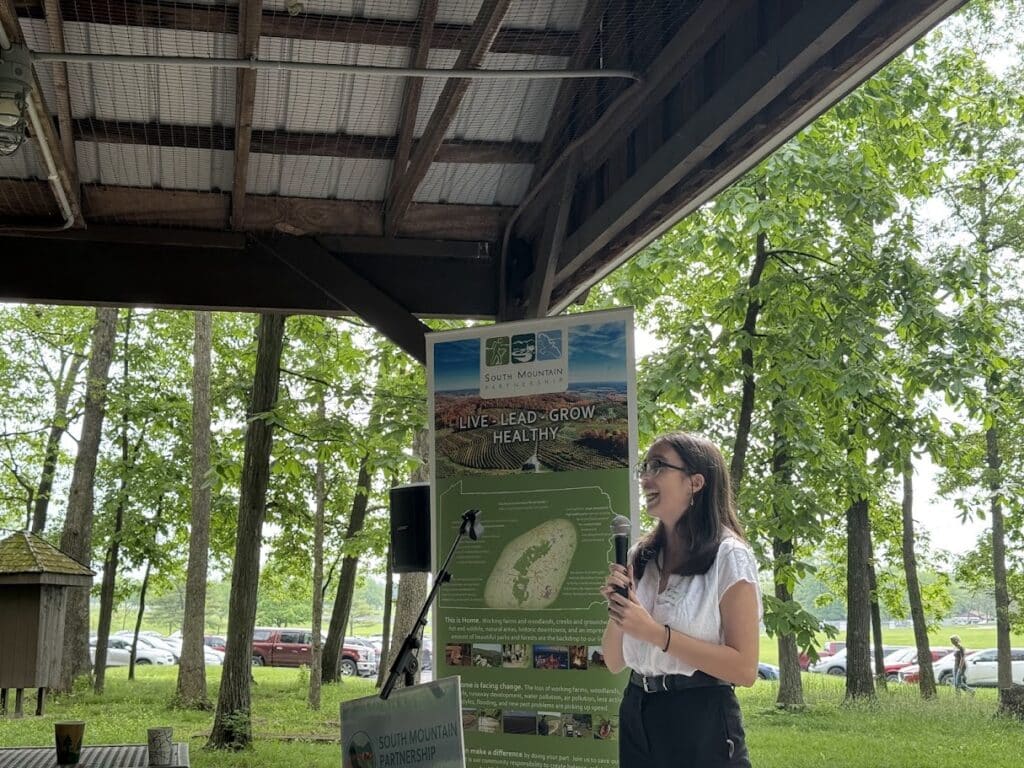
This study reveals PM pollution to be higher in the Cumberland Valley due to the warehouses, highways, truck traffic, and mountains that trap the pollution. Citizens and decision makers should consider both the positive economic impacts and the negative health and environmental impacts of warehouses.
Timothy W. Hawkins, Professor
Department of Geography and Earth Science
Dive into the Research
Executive Summary
Warehousing is a major industry in the Cumberland Valley (CV). This study evaluates the economic, environmental, and monetized public health impacts of warehousing in the CV. Key findings are summarized as follows:
- Warehouse development: 200 warehouses were identified in the CV. Of these, 66% were established before 2003. Average warehouse size increased from 9.71 acres in 2003 to 20.25 acres in 2022.
- Truck traffic: Truck traffic increased by 20.8% on I-76 and 43.5% on I-81 between 2001 and 2023.
- Temporal and seasonal PM2.5 patterns: PM2.5 concentrations are highest at night, with a secondary peak during the morning commute. Seasonally, PM2.5 concentrations are highest in summer, followed by winter, and lowest in spring and fall. Annual PM2.5 concentrations declined by 45-51% between 2001-2024, with the largest decrease occurring in summer.
- CV vs. non-CV PM2.5 (EPA data): Average PM2.5 concentrations are 14% higher inside the CV than outside, with a maximum difference of 31% in winter and minimum of 3% in summer. Reductions in PM2.5 concentrations over time are greater inside the CV than outside.
- CV vs. non-CV PM2.5 (PurpleAir data): PM2.5 concentrations are 3.44-5.39 μg/m3 higher inside the CV compared to outside the CV.
- CV vs. non-CV AOD (Satellite data): Annually, aerosol optical depth (AOD) is 5-10% higher in the CV compared to the non-CV areas with AOD hotspots at each exit along I-81. AOD has decreased 18-21% between 2001 and 2024.
- Regional PM2.5 drivers: Mid Atlantic PM2.5 concentrations are highest in summer, followed by spring, fall, and winter. High PM2.5 days are associated with persistent high-pressure systems rather than passing cold fronts, characterized by higher sea-level pressure, lower wind speeds with more southerly flow, warmer temperatures, and higher humidity.
- Warehousing PM2.5 emissions: PM2.5 emissions from the warehousing industry in the CV declined by 45% between 2014 and 2020. The CV was expected to account for 0.06% of U.S. and 3% of Pennsylvania warehousing PM2.5 emissions but actually contributed 1% and 16%, respectively, indicating a disproportionate regional impact.
- Economic output and monetized health impacts: In 2020, warehousing in Franklin County generated $750 million in GDP and $2.5 million in PM2.5 related health costs. From 2014-2020, warehousing GDP increased 30% ($170 million), while health costs declined by 66% ($5.6 million). Health costs, as a share of warehousing GDP, fell by 76%, from 1.60% to 0.38%.
About the South Mountain Research Corps
A collaborative research program that supports academic institutions and the existing and emerging natural and cultural resource conservation efforts throughout the South Mountain landscape.
Stay tuned for a July virtual South Mountain Research Summit where this research and more will be presented.
The South Mountain Partnership is a network of people and organizations working toward common goals. As such, this program is envisioned as one facilitated by the Partnership and managed by a working committee of stakeholders from throughout the region.
Contact Julia Chain for more information at jchain@appalachiantrail.org